Snapchat planets are a visual ranking system that shows exactly where you stand in someone’s best friends list. If you’re using Snapchat Plus and see planets like Mercury, Venus, or a red planet on Snapchat next to a profile, it’s not random decoration. It’s a clear indicator of interaction strength based on snaps, chats, and engagement. In short: the closer the planet is to the Sun, the closer you are to that person on Snapchat.
This guide breaks down the snapchat planets order, explains what the planets mean on Snapchat, and shows how the Snapchat solar system works in real usage—no guessing, no fluff.
What Are Snapchat Planets and the Friend Solar System
The Snapchat solar system is a Snapchat Plus feature that turns your best friends list into a miniature universe. You are the Sun. Your top eight friends orbit around you as planets, ranked by interaction.
The more you snap, chat, and react with someone, the closer their planet is to you. This is why planets on Snapchat are not mutual by default. You might see yourself as Mercury in someone’s system, while they appear as Mars or Jupiter in yours.
This feature is exclusive to Snapchat Plus, which is why free users don’t see the snap planet order at all.
How Snapchat Determines Planet Order
Snapchat does not publish an exact formula, but based on consistent testing, the snapchat planet order is driven by:
- Snap streak frequency
- Direct chats and replies
- Story reactions and views
- Recency of interaction
It is not based on followers, Bitmoji proximity, or profile visits. Two users can message daily but still rank lower if one side initiates most interactions.
Think of it as weighted engagement, not just volume.
Snapchat Planets in Order and Their Meanings
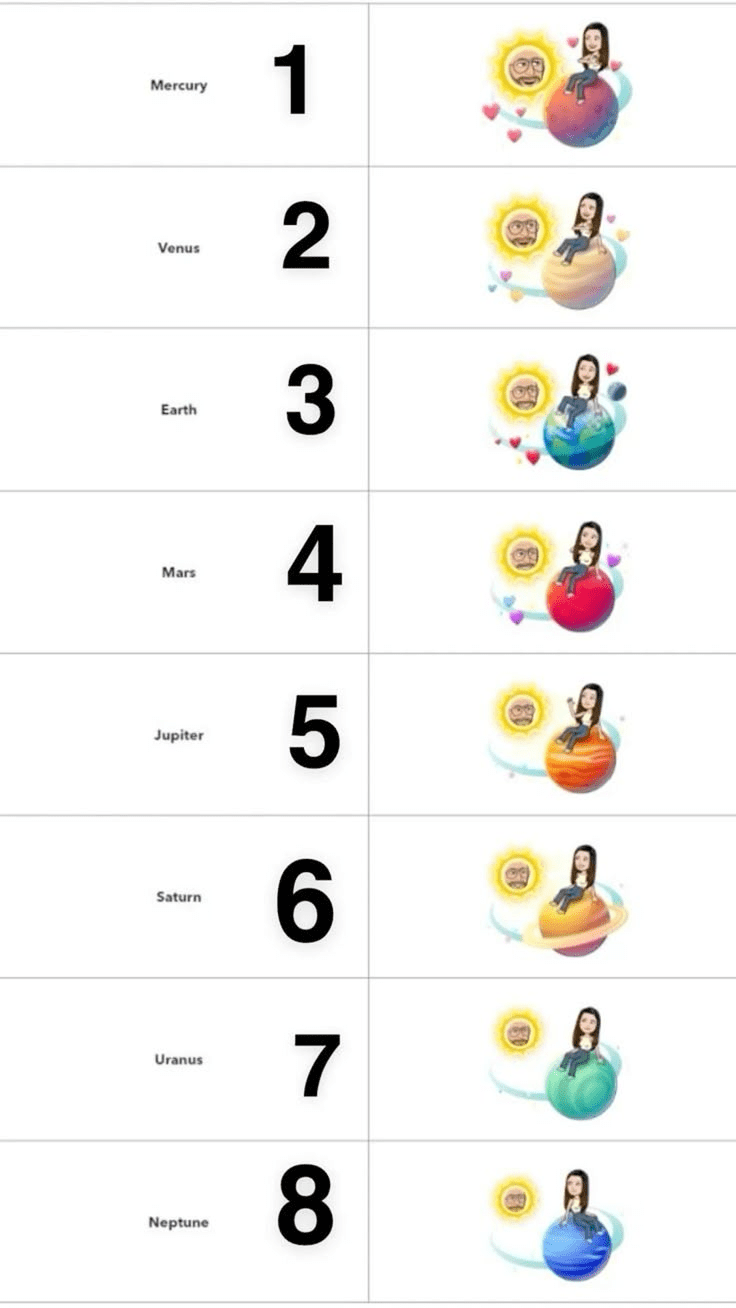
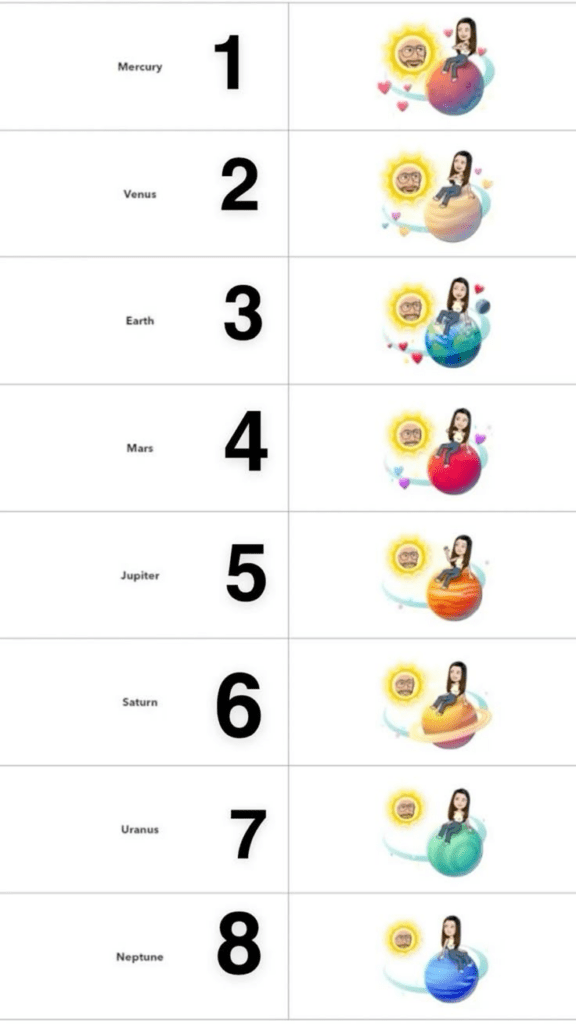
Below is the official snapchat solar system order, which mirrors the real solar system.
Mercury — Your #1 Best Friend

Mercury is the closest planet to the Sun and represents your top best friend. This is the person you interact with the most.
On Snapchat, Mercury appears as a small orange or red planet with hearts around it. If you’re seeing a red planet Snapchat icon with hearts, you’re looking at the strongest connection in that solar system.
Typical behavior:
- Daily snaps and chats
- Long Snap streaks
- Frequent story replies
Venus — Second Closest Friend
Venus comes next in the snapchat planets order. It signals a very strong bond, just slightly behind Mercury.
The Venus planet usually has sparkles and hearts, but fewer than Mercury. Interaction is still frequent, just not dominant.
Good example: You snap every day but don’t always chat.
Earth — Third Best Friend
Earth represents balance. This is a friend you interact with often, but not obsessively.
You’ll usually see hearts, stars, and a small moon around Earth. In the snapchat best friends list planets system, Earth means consistent engagement without being constant.
Mars — Fourth Position
Mars is your fourth closest connection. This is often someone you snap regularly but don’t chat with much.
Mars appears as a red planet with colorful hearts or stars. Many users confuse Mars with Mercury, but Mars always has fewer hearts and sits farther from the Sun.
Jupiter — Fifth Best Friend
Jupiter is where interaction starts to drop noticeably.
This friend:
- Receives snaps often
- Gets fewer replies or reactions
- May not chat daily
In the snap planets order, Jupiter is a sign of steady but casual engagement.
Saturn — Sixth Position
Saturn represents a mutual but low-intensity connection.
You might:
- Maintain a streak
- Rarely chat
- Seldom react to stories
The ringed planet Saturn makes this one easy to identify in the snapchat planet list.
Uranus — Seventh Best Friend
Uranus signals irregular interaction. You might snap occasionally, but there’s no routine.
This planet often has no hearts, which is why users think something is “wrong.” It’s not. It simply means low engagement.
Neptune — Eighth and Last Planet
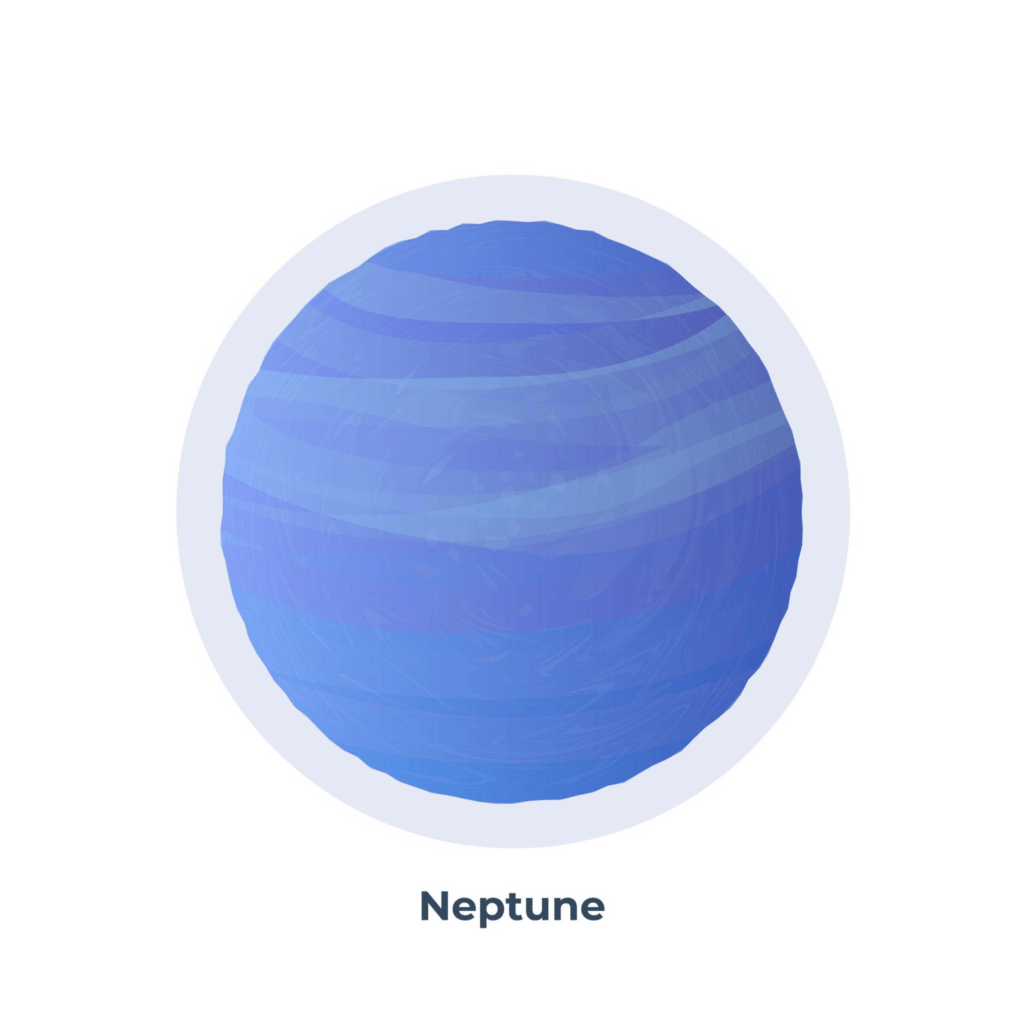
Neptune is the farthest planet in the snapchat planets order best friends system.
This friend:
- Rarely snaps with you
- Has minimal interaction
- May drift in and out of your list
If you see Neptune, you’re still in the top eight—but barely.
Snapchat Planets Order Table (Quick Reference)
Snapchat Solar System Planet Order and Meaning
| Planet | Snap Planet Order | Meaning on Snapchat | Interaction Level |
| Mercury | 1 | #1 best friend | Extremely high |
| Venus | 2 | Very close friend | Very high |
| Earth | 3 | Strong, balanced | High |
| Mars | 4 | Active but less chat | Medium-high |
| Jupiter | 5 | Regular snaps | Medium |
| Saturn | 6 | Mutual, low chat | Medium-low |
| Uranus | 7 | Occasional | Low |
| Neptune | 8 | Rare interaction | Very low |
This table summarizes how planets on snap reflect real usage, not labels.
How to See Planets on Snapchat Plus

To view planets snapchat style, you must be subscribed to Snapchat Plus and enable the feature.
Steps:
- Open your profile
- Tap Snapchat+
- Enable Solar System
- Open a friend’s profile
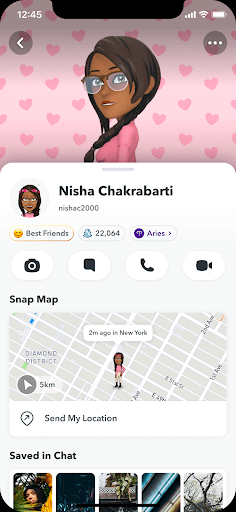
- Tap the Best Friends badge
If you see a gold badge, you’re in each other’s top eight. If you see a gray Friends badge, you’re only in their list—or they’re not in yours.
Why Snapchat Planets Might Not Show Up
If planets on Snapchat are missing, it’s usually for one of these reasons:
- No Snapchat Plus subscription
- Solar system toggle is off
- You’re not in the best friends list planets range
- App is outdated
- Very low interaction history
Clearing cache or updating the app often fixes display issues.
What Snapchat Planets Really Mean for Users
Here’s the key insight most guides miss: snapchat planets meaning is relative, not absolute.
Being Mercury in one solar system doesn’t make someone your best friend universally. It only reflects how you interact with that specific user.
This prevents social pressure and keeps the system private, which aligns with Snapchat’s design philosophy.
In simple terms: planets snapchat shows patterns, not popularity.
Snapchat Planet Meanings in Real-Life Scenarios
To really understand what the snapchat planets meaning reflects, it helps to look at practical behavior patterns. Snapchat’s algorithm doesn’t reward passive presence. It reacts to what you actually do inside chats.
Here are a few realistic examples based on how the snapchat solar system behaves in 2025.
Case 1: You and Alex snap daily, keep a streak, and reply to stories. Alex almost always appears as Mercury or Venus in your snapchat planets order.
Case 2: You snap Priya once every few days, rarely chat, but keep a loose streak. Priya often lands around Mars or Jupiter in the snap planet order.
Case 3: You have a long history with Daniel but barely interact now. Even if you were once close, Daniel slowly moves outward toward Uranus or Neptune.
The system is dynamic. Planets on snap change as your habits change.
Snapchat Best Friends List Planets vs Emojis
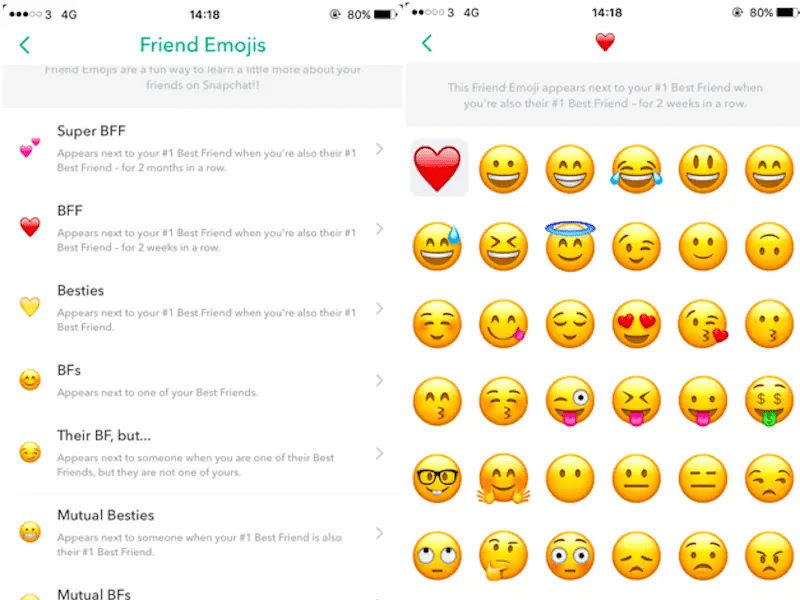
A common point of confusion is the difference between snapchat best friends list planets and standard Snapchat emojis.
They are not the same system.
- Emojis like ❤️, 💛, 😊 are mutual and visible in chats
- Planets on Snapchat are private and visible only to Snapchat Plus users
- Emojis reflect streaks and mutual status
- Planets reflect ranking position in the solar system snapchat model
You can have a heart emoji with someone and still appear as Earth or Mars in their system. That’s normal.
Snapchat Plus Planets: What You Can and Can’t Control
Many users try to “game” the snapchat plus planets system. In reality, control is limited.
What works:
- Consistent snapping (not bulk sending)
- Balanced chats and replies
- Genuine back-and-forth interaction
What doesn’t work:
- Mass snaps to everyone
- Leaving chats on read
- Watching stories without reacting
Snapchat prioritizes reciprocity. One-sided effort rarely moves a planet closer to the Sun.
Snapchat Planet Order Changes: How Fast Do They Update?
The snapchat planet order is not fixed daily, but it updates regularly.
Based on observed behavior:
- Minor shifts can happen within 24–48 hours
- Larger changes take several days of consistent interaction
- Sudden drop-offs can push a planet outward quickly
This explains why users sometimes see a red planet Snapchat icon disappear or change overnight.
Snapchat Solar System Order Is Not Mutual
One critical detail: snap solar system order is personal.
You might see someone as Venus, while they see you as Earth or Mars. This doesn’t mean one person values the friendship more. It simply reflects usage patterns.
Snapchat avoids mutual ranking to prevent social friction. The system is intentionally asymmetric.
Snapchat Planets Numbered: Quick Breakdown
For clarity, here is the snapchat planets numbered from closest to farthest:
- Mercury
- Venus
- Earth
- Mars
- Jupiter
- Saturn
- Uranus
- Neptune
Any friend outside this list does not appear in the planet snapchat system at all.
Red Planet Snapchat: What Users Usually Misread
The red planet Snapchat users talk about is almost always Mercury or Mars.
How to tell the difference:
- Mercury has multiple hearts and sits very close to the Sun
- Mars has fewer hearts and visible space between orbits
If you see a red planet with minimal decoration, it’s likely Mars, not your top best friend.
Planets on Snapchat: What They Don’t Mean
It’s just as important to understand what planets on Snapchat do not represent.
They do not show:
- Emotional closeness
- Real-life friendship strength
- Trust or loyalty
- Who likes whom more
They only show interaction frequency inside the app.
This distinction matters, especially for younger users who overinterpret rankings.
Snapchat Planet List vs Regular Friends List
The snapchat planet list only applies to your top eight interactions.
Your regular friends list:
- Can include hundreds of users
- Is not ranked visually
- Has no solar system context
The planets snap feature is deliberately limited to avoid turning Snapchat into a competitive leaderboard.
How to Use Snapchat Planets the Right Way
The snapchat planets order is best used as a personal insight tool, not a judgment system.
If you want to move closer in someone’s solar system:
- Interact naturally
- Respond, don’t just send
- Keep it consistent, not forced
If someone drifts outward, it’s usually about timing, not intent.
Used correctly, the snapchat solar system adds clarity without pressure. It quietly shows who you’re actually talking to—not who you think you are.